
In 2026, the AI search marketing niche has reached 32 billion yuan, and the short video operations outsourcing market has surpassed 80 billion yuan — according to iResearch's "2026 China AI Marketing White Paper," the traditional combination of a shooting team plus a professional editor is being replaced by AIGC toolchains.
For e-commerce companies, the question is no longer "should we use AI for advertising," but "how do we find a reliable production partner to outsource to?" Based on real project data from the aigcsdm.com platform, this article details the complete process from budget planning to acceptance and delivery.
I. Reasonable Budget Ranges for AI Advertising Production
Let's start with the conclusion: based on content type and production cycle, the mainstream pricing is as follows —
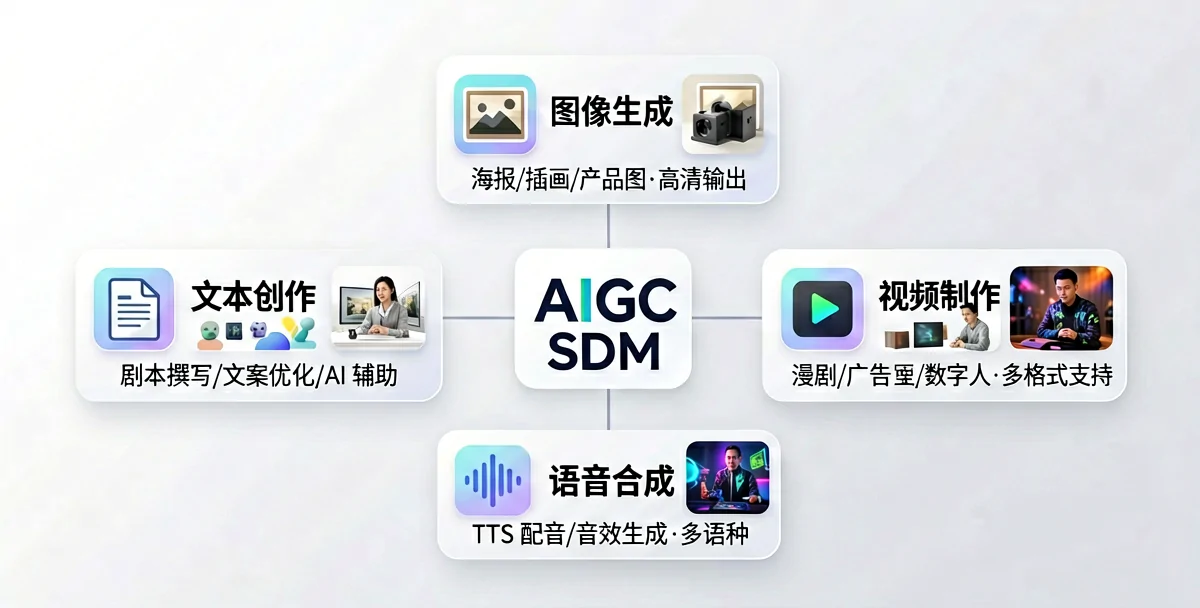
E-Commerce Product Hero Images (Static Posters)
Basic tier: 1-5 yuan per image — single product cutout on a white background with simple background rendering. Suitable for daily new product listings on platforms like Taobao/Pinduoduo.
Advanced tier: 100-300 yuan per image — multi-scene composition with custom brand VI (such as specific color palettes, fonts, and logo embedding). Suitable for the main visual posters on Tmall flagship stores.
Film-grade: 300+ yuan per image — 4K ultra-clear resolution with complex lighting effects. Suitable for annual campaign key visuals for premium brands.
Short Video Ads (15 seconds – 60 seconds)
Basic tier: 100-200 yuan per video — product carousel with subtitle voiceover, suitable for Douyin feed ad placements.
Advanced tier: 300-500 yuan per video — digital avatar on-screen with custom scripted storyline. Suitable for daily content updates on brand official accounts.
Film-grade: 1,000+ yuan per video — fully AI-generated cinematic-quality ad film, including original music and visual effects compositing. Suitable for holiday promotion TVCs for top-tier brands.
II. Service Workflow: 7 Key Stages from Brief to Delivery
Step 1: Submit the Project Brief (Client)
Clearly define the following information: product type / target audience / distribution channels / budget cap and expected delivery timeline. The more detailed the brief, the more accurate the producer's quote will be.
Step 2: Requirement Matching + Proposal Pricing (Platform)
aigcsdm.com pushes 3-5 producers to bid based on project type, and the client selects the best team based on portfolio quality and pricing. This stage takes 1-2 business days.
Step 3: Deposit Payment + Production Kickoff (Both Parties Sign)
The advance payment ratio is typically 50%, with the remainder paid after acceptance. The contract should clearly specify the maximum number of revisions (3 free revisions recommended) to avoid endless rework.
Step 4: First Draft Delivery (Producer)
E-commerce posters typically deliver a first draft within 24 hours; short video ads require 3-5 business days, covering three stages: scriptwriting, storyboard design, and AI generation.
Step 5: Client Feedback + Revisions (Typically 1-2 Rounds)
Revision scope is limited to adjustments agreed upon in the brief. If the client requests a complete redo (such as changing the product or altering the core concept), additional charges apply.
Step 6: Final Delivery + Remaining Payment Settlement (Both Parties Confirm)
The producer provides source files (PSD/PR project files or AI generation logs) + finished exports (JPG/MP4). Copyright transfer is governed by contract terms.
Step 7: After-Sales Guarantee (Typically 30 Days of Free Minor Adjustments)
Some producers offer performance tracking services — if the ad's CTR falls below the industry average, they will optimize 1-2 versions for free. This is an important bonus when selecting a quality service provider.
III. Acceptance Criteria: How to Determine if an AI Ad Is Up to Standard?
The acceptance checklist established by the aigcsdm.com platform covers the following dimensions:
Visual Quality (Weight: 40%)
Product accuracy >= 95% (color, texture, and details must match the physical product, avoiding color shifts or distortions caused by AI hallucinations)
Resolution meets standard: e-commerce hero images 1200x1200 pixels or above; short video ads 1080p minimum, 4K is a bonus
Brand VI consistency: logo placement, standard colors, and font specifications must strictly follow the client's Brand Guide
Copy Compliance (Weight: 30%)
Zero occurrences of words prohibited by advertising laws (such as "best," "number one," "absolute," etc.)
Accurate selling point extraction, avoiding exaggerated claims that risk customer complaints
Multi-language translations must be proofread by native speakers (essential for brands going overseas)
Conversion Orientation (Weight: 30%)
Core CTA buttons must be clearly visible (calls to action like "Buy Now" and "Limited-Time Offer" must stand out)
The 3-second golden rule: the first 3 seconds of a short video ad must deliver visual impact or an emotional hook, otherwise the completion rate will plummet

IV. Pitfall Avoidance Guide: Five Common Disputes
Dispute 1: "Does AI-generated content count as original?"
The country's first criminal case involving AI short drama infringement has made it clear — AIGC content with substantial human involvement is protected under copyright law. However, the contract must specify: whether the models and asset libraries used by the producer carry any third-party copyright risks (such as images in training data). It is recommended to require the producer to provide a "No Infringement Commitment Letter."
Dispute 2: "Can I get a refund if the results are poor?"
The performance of AI ads is influenced by multiple factors including distribution channels, target audience, and budget — it cannot be simply attributed to the quality of the creative assets. The recommended contract clause is: if the CTR falls more than 20% below the industry average, the producer will optimize 1-2 versions for free; if it still fails to meet standards after more than 3 attempts, 50% of the final payment may be refunded.
Dispute 3: "Should source files be delivered?"
This depends on your downstream needs — if the company plans for an internal team to take over iteration, you must require delivery of AI generation logs and parameter configurations (such as ComfyUI workflow nodes); if it's for one-time use only, the finished export is sufficient.
V. How to Choose a Reliable Producer?
The screening logic of the aigcsdm.com platform can serve as a reference:
Look at case studies, not promises
Request at least 3 successful cases in the same product category (such as beauty/3C/food) from the producer, along with screenshots of performance data (CTR, conversion rate, and ROI). Saying "we can do it" means nothing without real data to back it up.
Test communication efficiency
Observe the producer's responsiveness and professionalism during the brief stage. If they cannot even clearly understand your product's selling points, the production process will definitely go off the rails.
Confirm tech stack transparency
Quality producers will proactively disclose the AI toolchain they use (such as GPT Image 2/ComfyUI/HappyHorse) and explain why they chose those models. Teams that conceal technical details are usually hiding capability gaps.
Conclusion: The Essence of Outsourcing Is "Trading Budget for Time"
The core advantage of e-commerce companies lies in their supply chain and operations, not in content production. Delegating AI advertising to a professional team is essentially using a controllable budget to purchase guaranteed delivery results.
The matching mechanism of the aigcsdm.com platform solves the information asymmetry problem — after a client publishes their requirements, 3-5 producers bid with quotes, and the platform supervises every stage until acceptance is approved. This model allows business clients to avoid the risk of "ending up with a disreputable team and losing everything."


