
In 2026, the number of AIGC content production vendors has become overwhelming. From enterprise-level product lines of major internet companies to individual studios, pricing ranges from a few thousand to hundreds of thousands of yuan — how do you choose? We interviewed multiple enterprise leaders with actual procurement experience and compiled this guide to help you avoid common pitfalls.
I. Clarify Your Own Requirement Boundaries First
Before reaching out to vendors, it is recommended to internally clarify three questions: Do you need finished product delivery or technical empowerment? What is your budget range? Is there a hard deadline for delivery? The answers to these three questions directly determine what type of vendor you should seek.
If you need to mass-produce e-commerce hero images or short video assets, prioritize platform-type vendors with standardized product lines; if it is a highly customized project such as a brand promotional video, focus on evaluating the vendor's creative team and project management capabilities.

II. Six Core Evaluation Dimensions
Dimension 1: Technology Stack Transparency (Highest Weight)
A reliable vendor will clearly tell you which models and tools they use. For example, whether they use Midjourney v6 or Stable Diffusion for image generation, Seedance 2.0 or LTX-2.3 for video animation, and Qwen-TTS or ElevenLabs for voiceover TTS — different technology combinations directly affect the quality of the final product and the flexibility of subsequent modifications.
If the vendor is evasive about your technical questions or only says "We use the latest AI technology," it is recommended to pass. This usually means they either lack sufficient technical capabilities or are subcontracting the work.
Dimension 2: Case Authenticity and Industry Fit
Ask vendors to provide publicly verifiable case links (such as live e-commerce pages or published video platform works), not PPT screenshots. Focus on projects in the same industry as yours — a vendor experienced in beauty brands may not be skilled in industrial product promotional videos. Vertical industry experience accumulation matters.
Dimension 3: Standardization of Delivery Process
A mature vendor should have clear project milestone breakdowns and acceptance criteria. Using AI comic drama production as an example, the standard process should include five key milestones: script confirmation, storyboard design, character design draft review, initial version preview, and final delivery. The number of revisions and response time for each milestone should be clearly specified in the contract.
Dimension 4: Data Security and Copyright Protection
This is the dimension where pitfalls are most common. Ensure the contract confirms: ownership of AI-generated content copyright (current judicial practice tends to rule in favor of the commissioning party, but contract clauses are needed for support); whether training data involves infringement risks; and whether your trade secrets (such as unreleased product images) could be leaked to third-party platforms.
Dimension 5: After-Sales Maintenance Capability
AIGC content is not a one-time delivery. Assets may need text and color adjustments for holidays or promotional campaigns, and videos may need to be adapted to different platform aspect ratios. Confirm whether the vendor offers a free revision quota and the pricing structure for revisions beyond that.
Dimension 6: Pricing Transparency and Value for Money
Beware of the "low-price hook + hidden fees" model. Some vendors' quotes appear cheap on paper but add charges at delivery time claiming "AI generation quality is unstable and requires extra adjustment hours." Request that the vendor provide a complete pricing list that includes all possible fees.
III. Summary of Common Procurement Pitfalls
Pitfall 1: Overpromising Technical Capabilities
"We use a proprietary AI model that performs three times better than Midjourney" — this kind of claim warrants a question mark. Currently, mainstream AIGC vendors' technical foundations are still open-source or commercial large models such as GPT-4o, Claude, and Stable Diffusion. Teams with genuine in-house R&D capabilities are extremely rare.
Pitfall 2: Passing Off Human-Created Works as AI-Generated
Some vendors mix traditional design team works into their case portfolios to inflate expectations. Ask the vendor to demonstrate the complete process from prompt to final product on the spot to verify actual production capacity.
Pitfall 3: Vague Contract Clauses on Copyright
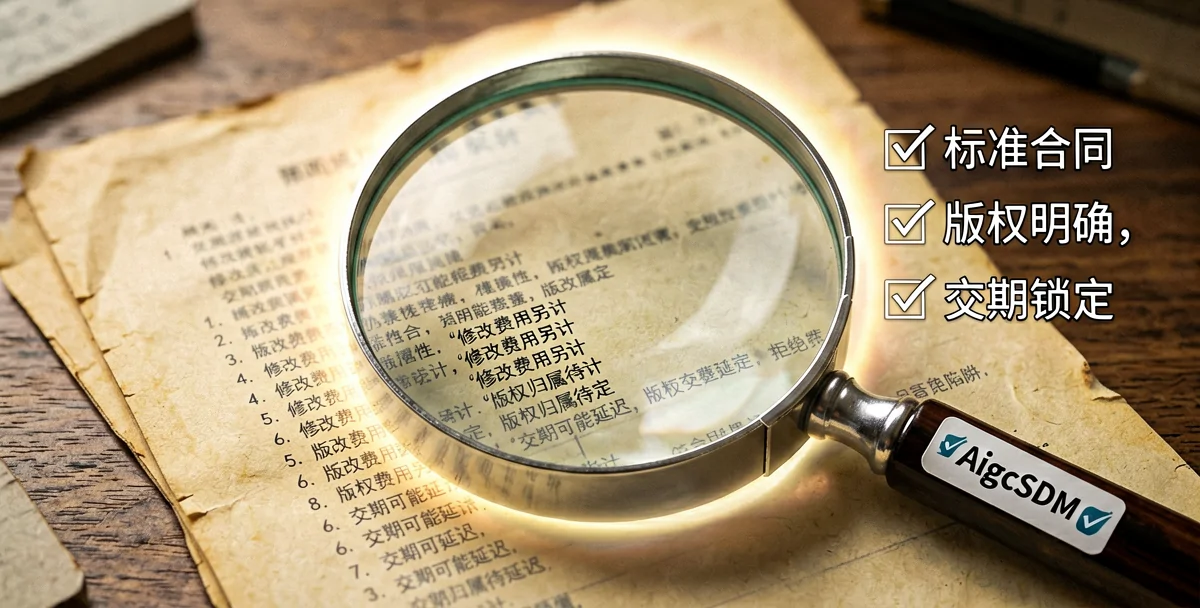
Standard contracts must clearly state that intellectual property rights of AI-generated content belong to the commissioning party, and the vendor may not resell the same set of assets to third-party clients. Be sure to have your legal team review this clause.
IV. Recommended Procurement Process
Step 1: Send a requirements brief to 3–5 vendors, requesting preliminary proposals and quotes; Step 2: Shortlist two vendors for a small-scale trial order (budget controlled within 5,000 yuan) to verify actual delivery quality; Step 3: Based on the trial order results, select a long-term partner and sign a framework agreement specifying settlement cycles and SLA standards.
Visit aigcsdm.com Services Overview to learn about our technology stack and service process. We provide full-category content customization outsourcing services including AI comic dramas, AI advertising, AI digital humans, and more.


